
Updates
A new study by Ali Hajizade has been published: Crisis Communications from the Pre-Internet Era to Generative AI

10/07/2026, 07:04
In June 2026, an article by Ali Hajizade was published in the journal Frontiers in Business Innovations and Management “The Evolution of the Theoretical Foundations of Crisis Communication from the Pre-Internet Era to the Age of Generative Artificial Intelligence”. This is another academic paper on the impact of artificial intelligence on crisis communications, a continuation of his 2025 study on deepfakes.
In this article, the author examines how the theory and approaches to crisis communications have changed over three technological eras. The classic model was built around a simple logic: an event occurs, the organization interprets it, assesses responsibility, chooses a response strategy, and protects its reputation. This scheme worked for decades because a crisis always began with a real incident: an accident, a scandal, a mistake, a public accusation, an information leak.
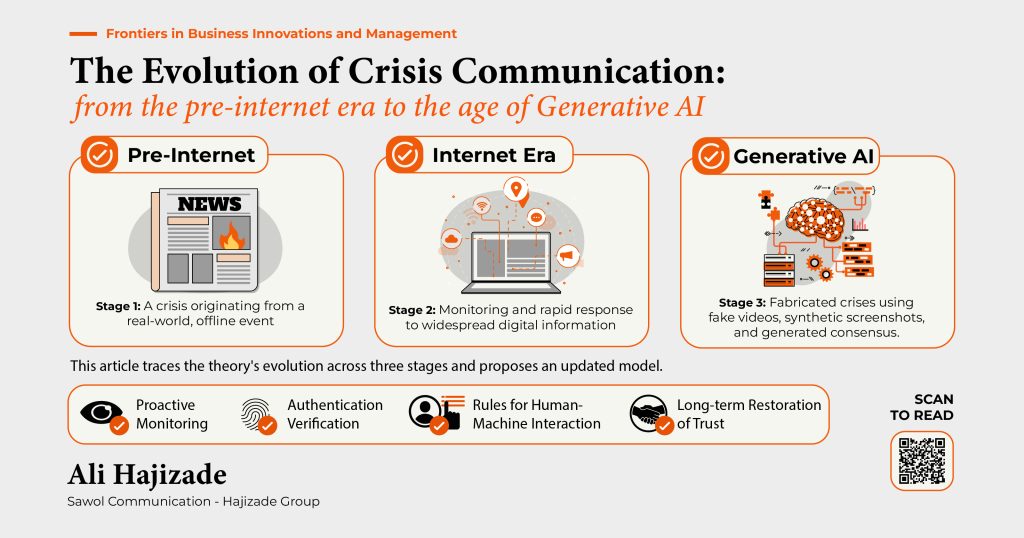
Generative AI, as Hajizade demonstrates, breaks this logic. Today, a crisis no longer requires a real event. Fabricated “evidence,” cloned executive voices, synthetic screenshots, fake document “leaks,” and artificially created “consensus” by bots can create a full-blown reputational crisis from scratch. A speed gap arises: a crisis is generated faster than the organization can recognize it.
Based on an analysis of ten contemporary scientific publications, the author traces the evolution of the theory through three stages: the pre-Internet era, the period of adaptation to the Internet and social media, and the current stage of generative AI, and proposes an updated model of crisis communications. Its core consists of four functions: proactive monitoring of synthetic threats, an authenticity verification infrastructure, rules for separating responsibility between humans and machines, and long-term trust restoration after refutation.
The practical conclusion of the article is addressed to PR and reputation management specialists: refutation no longer solves the problem on its own. Before an audience will trust any response from an organization, they need a reliable “reality layer,” verified sources, confirmed authenticity of the materials, and visible human responsibility for the communication.
The article is published in open access. The full text is available at this link: https://irjernet.com/index.php/fbim/article/view/454

New article: Cognitive warfare and the limits of classical crisis communication models

Ali Hajizade Receives Millionaire Concept Award for Transformative Contributions to PR
New Research by Ali Hajizade on Crisis Communications in the Era of Deepfakes